Tuesday, July 8, 2014

Climate and Chickens in the Classroom (Colleen)

Yesterday was a day of firsts. I went to the schools closer to Nanyuki for the first time. I saw a school with a park for the first time. I experienced Kenyan rain for the first time. I saw a chicken invade a classroom for the first time. Yep, a chicken.

I hadn’t really thought that there would be much of a difference between the schools closer to the major town and those farther away, and was surprised that there were noticeable differences. The greatest difference was something that is so common in American classrooms that I hadn’t really noticed their absence in other schools—backpacks. A fair number of the students in this particular school had some sort of backpack or bag to carry their things. The mere presence of these bags reminded me that aside from a few homemade satchel-like bags, I hadn’t seen any bags. I was trying to figure out why these students might have them and think the proximity to town is key, as the kids will have more access to various resources there. It may also reflect the ability of teachers to assign homework, which would require students to have some means of carrying their belongings. Dan said most of the rural schools don’t assign homework because students only have an hour or so of daylight when they get home, making completing assignments rather difficult. Again, I feel like the ability to assign homework is probably tied to the proximity of town and greater access to resources.

That said, the school is definitely still rural. The families who live on campus have both goats and chickens (one of which managed to join our class for a bit this afternoon!) and agriculture plays a central role in the lives of the students through their parents. You can’t drive anywhere without seeing a herder with his or her flock of goats, camels or cows (which are especially important to the Maasai). All of these animals are in competition for resources (especially grass and water) with each other and wild animals. This competition has ultimately led to wild animals like Grevy’s zebras becoming endangered and the migration of domesticated animals to areas with more rainfall and consequently more grass. This affects students’ education because if their parents are forced to move with the livestock, they pull their children from school and travel as a family. The head teacher (principal) said that this has already started to happen due to the current drought, and as he said “the parents care more about their cows than education.”

Ultimately, the Northern Kenyan Conservation Clubs can help to address the issues that contribute to the relocation of livestock. The clubs promote awareness about the consequences of overgrazing and how to prevent it. Combined with planting trees and preventing soil erosion, this could all lead to better conditions for agriculture and hopefully minimize the need to relocate livestock. Hypothetically, the actions we encourage our students to take could ensure that their children don’t have to leave school.

This school particularly has been successful in planting trees. The school I visited today received some 500 saplings from the county government. In theory, this is great! Yet, we are in an area full of animals who love to eat trees (especially goats) and an area prone to severe drought. Planting and maintaining 500 saplings is simply unrealistic. The school tried to make the best of the situation and planted many of the trees around the grounds, even cultivated a small park. The conservation club built protective coverings for many of the trees to prevent destruction by goat. The club and its teacher (who has been integrating more experiential learning in his teaching after attending a workshop organized by Nancy) are very proud of their work and the teacher told me to make sure I took photos of their other projects, including a wind vane and a wind sock.

While at the school, I experienced my first Kenyan rain. The school, like many Kenyan buildings, has a tin roof. The rain was pouring so hard that it was nearly impossible to hear the person next to you. Alex was able to mold her teaching into a type of charades and still managed to get some great answers! The rain entered the class room through the “windows” (really just openings between the cinder blocks). I was most stuck by the students’ reactions to the rain. While our students listened (or attempted to listen) to Alex, other students ran out to catch the water in their lunch bowls. Some even took water bottles and tried to fill them with the overflow from the gutters. At Mpala, we are definitely conscious about water use, but it was amazing to witness people who lack water to the point of needing to drink rain water.
Species like Grevy's zebras are becoming endangered because of loss of habitat, often due to competition with domesticated animals. Also, that is NOT a lion in the background.
Students constructed protective coverings for many of the school's newly planted saplings.

The windsock and windvane the club made. The tire rim is used as a type of gong to sound the end of the day.
Clean water tanks are located at all of the schools. Students fill their bowsers with clean water and carry it home, often a journey of several kilometers.

Students attempting to fill their water bottles.
Alex had to use lots of hand movements to teach her lesson due to the deafening sound of the rain on the tin roof.

Dayton playing a four corners game with students, who had to choose which reason they think is contributing to different species' endangered status the most (human conflict, habitat loss, etc.)

Great minds think alike! Kate and Colleen had almost identical rainy weather outfits.


Reading The Lorax (Dayton)

With Community Conservation Day successfully complete, the Conservation Clubs are ready to move forward with a new project. Some schools (including Il Motiok and Naiperere, where we went yesterday) will be doing an “indigenous knowledge project:” next week we will go for a walk with a local Maasai elder who will tell the kids how the landscape has changed over the years. But that’s next week—first we needed to set that lesson up.

Colleen and I accompanied Annelies and Nancy to Naiperere, while Helen and Kate stayed with Alex at Il Motiok. Both schools began with a quick recap of Community Conservation Day; we had the kids write what they liked, what they learned, and what activities from other schools they wanted to try at their school. Predictably, they liked, the poems, songs, games, and dramas. I was somewhat more surprised that several wrote they liked all the speeches (which were mainly by adults and not targeted at the students), but hey, I’m thrilled they had a good time! We also watched a short video about the Clubs made last summer; it seemed super fun for the kids to see themselves on film.

Next we told them about the indigenous knowledge project. To prepare them, we shared a classic Western example of someone old telling someone young how the environment was destroyed: The Lorax! I hadn’t read Seuss’s eco-tract for probably over a decade, though I’d seen—and adored—the recent film adaptation. 43 years after publication, the book still packs a wallop. As Annelies and I read aloud to the kids, I found myself deeply invested. The students, more to the point, also seemed to enjoy it.

The book, in case you don’t recall, is the Once-ler’s account to a young boy of how his greedy younger self cut down all the “Truffula Trees,” filled the air with smog, and dumped “Gluppity-Glupp” into the water (forcing all the local fauna to leave) as he expanded his factory. Specifically, he sewed the Truffula leaves into “Thneeds” (which everyone needs!), multi-purpose sort of sweater-looking things that become inexplicably popular. Inexplicable to both the reader and to “the Lorax, who speaks for the trees,” a fantastical (and fantastically mustachioed) little orange man who tries to stop the Once-ler’s rampage of deforestation. Alas, the Once-ler only stops once he has chopped down every Truffula Tree, leaving the local ecosystem devastated and his own Thneed business collapsed.

This would be a rather dour way to end a Dr. Seuss book, and so the Once-ler ends on a potentially hopeful note: “UNLESS someone like you cares a whole awful lot, nothing is going to get better. It’s not.” He then gives the young boy a seed—the last Truffula Seed!—and instructs him to plant it, grow it, and protect it: “Then the Lorax and all of his friends may come back.” Seuss never wrote a sequel so we don’t know if the young boy listened and became the steward of a thriving Truffula Forest, or if he just turned into another doomed-from-the-start Thneed magnate.

In a way, that’s been for us to decide—and results have been mixed. While the environmental movement has gained leaps and bounds since 1971, there are still whole sectors of the economy that, like the Once-ler, are intent on “biggering and biggering and biggering” in the short-term no matter how great the coming crash might be. This is especially relevant in the States: while we certainly remember Seuss’s contagious love for trees and animals, we forget that he also challenged our role as rampant consumers.

In Laikipia County, consumer culture is less the issue than the more direct message: cutting down trees hurts the animals. People here often cut down trees to burn charcoal, and as population booms, deforestation spreads, and the wildlife (not to mention livestock and the people themselves) suffers. The kids definitely understand this part, and to them the parallels of their situation with that of The Lorax were glaringly obvious. The story probably applies more literally here than it does in the US, where we’ve already cut down most of our trees and the public rarely sees deforestation happen directly.

Despite the good Doctor’s linguistic gymnastics, the class seemed to have followed the book well, and we had a productive discussion afterward. Though when we asked if they could say “Truffula Tree,” the class shot back with a resounding “No.”

The school had a relationship with a school in Limerick, Ireland.


Dayton reading to students

The administrative building. Students line up in rows marked by the rocks.

Sunday, July 6, 2014

The Big Event--Community Conservation Day! (Helen)

Community Conservation Day! What a spectacular, fun, and meaningful day! It was great to see the event go so smoothly and hear that the children had enjoyed themselves (or at least the four kids that I asked). It was the result of a lot of hard work and organization by many people, and I have to say that it was a huge success. 

Our day started early since we planned to leave by 7:15 am and get to Kimanjo Secondary School (which was where the event was being hosted) to set things up. We loaded the car with posters, books, and certificates for the students and the teachers. The posters were for each school who worked on a project to share with the other schools. For example, Mpala Academy prepared a poster on the amount of rain around Mpala, showing how the amount differed and how they recorded it. Kimanjo Primary School had created a “charcoal ball” project, in which they found that mixing cow dung and charcoal dust together, rolling it into a ball, and drying it is more environmentally friendly than just burning charcoal. The posters were all taped to a side of a building, with a group of students standing next to their poster to be able to explain what it was all about. I saw students asking each other to explain the posters and pictures (for example, one student pointed to a photo of feathers that Ewaso Primary School had and asked what kind of feathers they were). That’s really the point of Community Conservation Day; to share and teach each other what they’re learning about, and it was awesome to see students get excited about conservation.

Students walking around and looking at what the other schools had prepared (You can see that some of the students of same gender hold hands; that’s completely normal as well as frequent here, and it’s a sign of friendship and affection)
It was great because the students all had their school uniforms on, with their badge. (The badge has a logo that is unique to each school, and the logo has a picture of an animal that is special to the area surrounding the school. Ol Jogi Primary School, which is the newest club this year, held a logo contest - their winner was a cheetah!)

After the students had taken a look at the presentations and had a chance to share and learn about the individual projects, we all gathered together in the middle of the schoolyard. The event started with the Kimanjo Secondary Students who performed a traditional Masaai song and dance. They were excellent, and they had won multiple times in regional contests. After that, schools came up to present a game in which members of the community could participate. For example, Lekiji Primary School had a game called “What Animal Am I?” Each child came up and a picture of an animal was pinned to their back. They then asked some questions to the audience, such as “am I a mammal?” and “Do I live in the forest?” The audience would answer, and the student would then guess what animal he or she was. I thought that it was really great that some of the students would ask “Am I endangered?” since endangered species was a huge part of the lessons that we taught in the schools.

 My favorite game was by Ewaso Primary School called “Animal Actions.” A group of students would come up and imitate certain animal actions such as “tortoise being disturbed by a human,” or “elephants bathing.” It was great because the students were able to show the community the fun, excitement, as well as benefits of interactive and experiential learning. A lot of the students here learn mostly by rote memorization and repetition, and these games stimulate critical thinking (“Why am I playing this game? How does this game relate to the lesson we’re learning about the environment?”). It was great to see the students as well as the audience have fun. I know I definitely enjoyed myself.

After the games the students had prepared songs, poems, and a drama about environmental conservation. The poems and drama were all original and written by the school performing it. There was a drama about cutting down trees; the message was that if you cut down trees, it has negative long term effects, and human lives depend on trees. There was also a drama about poaching and how we shouldn’t hunt and kill endangered species.

Il Motiok performing “How We Conserve the Environment” in Maa. I thought that they were saying “yellow swordfish” in some places, but the whole thing was in Maa, which was great for the community.

Kate taking pictures throughout the event

After the student performances, students were given prizes for their Species on the Edge contests. There were about two students from each school, and they received a book. It was so cute because when the students would come up to shake Nancy’s hand and receive the prize, they looked very stoic and expressionless, but once they were in the crowd and amongst their friends, their faces lit up in huge grins. The winning essays identified an endangered animal, described its habitat and diet, why they were endangered, and what could be done to help them. It was especially challenging because the essay had to be written in the POV of the animal, which required creativity and descriptive language. Congratulations to the winners! 

The teachers then all received certificates as congratulations and thanks for their hard work in teaming up with the Conservation Clubs to educate students about the environment. One of the teachers, Raphael, also gave a short speech about the importance of experiential learning. I thought that it was so terrific how he mentioned that there are different types of intelligence (touching, artistic, musical, visual, etc), and experiential learning makes it possible to reach students by utilizing such differences. Raphael is a superb teacher; one day when we went to visit Olgigiri Primary School (which is where he teaches), we saw him outside with the kids, teaching them about the weather by using wind socks. I'm told that such teaching is rare, since most teachers here lecture in front of the class and check that their students understand and are paying attention by leaving off the last word and having them fill it in. (For example, a teacher would say, "trees need soil and wa--?" and the students would fill in the last word by saying "water.") 

There were also some concluding remarks by various members of the community. Someone pointed out that the point of Community Conservation Day was to share new ideas and learn from each other, but at the end of the day, everyone had to work together to “talk the walk.” Nothing will be accomplished if everyone just talks about ideas; each should take what he or she had learned and apply it to their lives. I thought that this was a great message, and it doesn’t just apply to members of the community but to us as well.

The kitchen; the huge stove is lit with wood, which is then used to cook the beans that the students had for lunch. The students were really excited about lunch, and it made me feel all the more thankful for what we have available to us in America. 

Saturday, July 5, 2014

Happy America Day! (Kate's 1st Post)

The 4th of July is referred to by our Kenyan friends as "America Day" and a great celebration was planned and executed with style at the Ranch house on Mpala. However, before the party got started, there were schools to visit and children to teach. The group split in two, with Annelise, Colleen and Helen heading out in the jeep to visit Ewaso Primary while Alex, Dayton and I hitched a ride over to the Mpala Academy, the primary school located on Mpala, walking distance from the ranch.

At Mpala Academy, it was food chain day and we started the lesson by reading the Great Kapok Tree to a rapt audience of primary school children who missed much of the English, but enjoyed the pictures. The Mpala Academy Conservation Club teacher translated the gist of the story into Swahili as each page was turned.

Dayton reading from the Great Kapok Tree
Once the story was over, the children were asked to name all of the animals that were characters in the story and after a little proding they were able to come up with them all, including humans. Then it was lesson time and Alex smoothly transitioned the class from the Great Kapok Tree story into a lesson on food chains, using the animals from the story to help illustrate the different levels of the food chain: producers, herbivores, carnivores and omnivores. The children had clearly heard these terms and learned these concepts before and were easily able to come up with examples of each from both the Amazon setting of the Great Kapok Tree and their own more familiar Kenya. After demonstrating a food web illustration on the chalkboard, Alex then gave the students some time to draw their own food webs which they did with gusto.

The awesome Alex teaching the class about food webs


Students hard at work on their own food webs

After the students had completed their food web drawings and shared them with their classmates, we took the class outside. I got my first taste of the hard work the students have all been putting in preparing for Community Day when the Mpala Academy Conservation Club performed their poem for us as a practice run to prepare for the big day tomorrow. I was blown away with the poise and talent of these primary school children and it got me incredibly excited for tomorrow's event.

After the dress rehearsal performance, we introduced the students to a game called Lions and Antelope which is just the Kenya version of Sharks and Minnows where you start with one predator and a heard of prey. The prey attempt to run from one end of the field to the other, while the predator tags as many as he can. Anyone who is tagged then becomes a predator. Its a great game because it gets the students running around but it also teaches a basic lesson on supply and population growth within an ecosystem.

Lions and Antelope!

When the game was over, it was time to say goodbye to the students. Usually at Mpala, we teach a computer class after the Conservation Club lesson, but today there was no power at the school, so we were not able to do the "Google search" lesson that Alex had planned for the day. The teachers also wanted to send the students home early, as they had to be back at the school at 6:00 am the following morning to get on the bus that would take them to Kimanjo Mixed Secondary School where Community Day is being held, over an hour drive away. (Blog post on Community Day to come tomorrow)

Once the work was over, it was time to celebrate...

HAPPY AMERICA DAY!

Eunice, the amazing cook at Mpala, prepared an American feast and Nancy and Dan Rubenstein had all of the researchers, grad students and undergrads (about 150 people) up to the ranch house for dinner. It was a great way to relax and meet more of the people living and working at Mpala. Before dinner we had a rousing Frisbee tournament in which much fun was had by all and then we ate until we thought we might explode while watching darkness fall over the breathtaking view that is Mpala.


Happy American Day Flag Cake!
The view from the ranch of Mpala


Thursday, July 3, 2014

48 hours later and we're here! (Colleen's first post)


Habari from Mpala! Despite the feeling temporarily narcoleptic, jetlag has not been too bad and Kate and I hit the ground running yesterday afternoon with school visits. We piled into the Land Rover alongside Nancy, Helen, Dayton and the two PEI interns, Alex and Annelies. Taking such a large group allowed us to visit three schools in total, Kimanjo Primary School, Kimanjo Secondary School and Ngabolo Primary School.

I went to Kimanjo Primary School with Alex, Helen and Dayton (Helen and Dayton later headed to Kimanjo Secondary School down the road). We took turns reading The Great Kapok Tree to the students, which promotes a message of stewardship for the Amazon Rainforest (each of the animals that lives in the tree or depends on it pleads with a man to not chop down the tree for different reasons). The book tied in perfectly to the themes of this particular club’s preparations for Community Conservation Day (a large event with all of the clubs coming together to share ideas and performances). The Kimanjo Primary School club had prepared a dramatic piece that compared two villages, one which was dedicated to preserving trees and one that cut the trees down. People in the area often cut down trees for fuel and to make charcoal, which ultimately has adverse effects on the wildlife by taking away food and shelter. In the drama, ultimately the village dedicated to planting and preserving trees flourishes. The villagers share their knowledge with the neighbors and by the end of the skit both villages are planting trees. The message of the skit fits with the mission of the Northern Kenyan Conservation Clubs. We’re trying to promote education about conservation within the clubs themselves, but also empower students to share that knowledge with their families and greater communities. Importantly, the skit is in English and Swahili, though the majority of the play is in Swahili, ensuring the bulk of the attendants will be able to understand it. The Kimanjo club continued to build on this theme with the demonstration they are planning to share on Community Conservation Day. The students made their own charcoal using dung and charcoal dust, eliminating the need for wood. They will share this technique with the community and hopefully others will follow their example.

Visiting the school gave me a bit more insight to what we’re trying to accomplish with this project. The Great Kapok Tree takes place in the Amazon, which is a world away for Kenyan students (and the vast majority of American students). We began by explaining and showing where Kenya and the Amazon are in relation to each other on the map. As we went through the different animals, we checked if the students knew what they were (boa constrictor and sloth in particular were problematic). This is the same sort of problem (so to speak) that will are attempting to address with this project. We want to make the lessons relatable to students and part of that is using biomes and animals they recognize and know. That said, we were able to relate the new animals to various Kenyan animals (i.e. a jaguar is like a leopard; a sloth is slow like a tortoise). We’ll definitely try to mimic that same sort of thinking in the American curriculum.

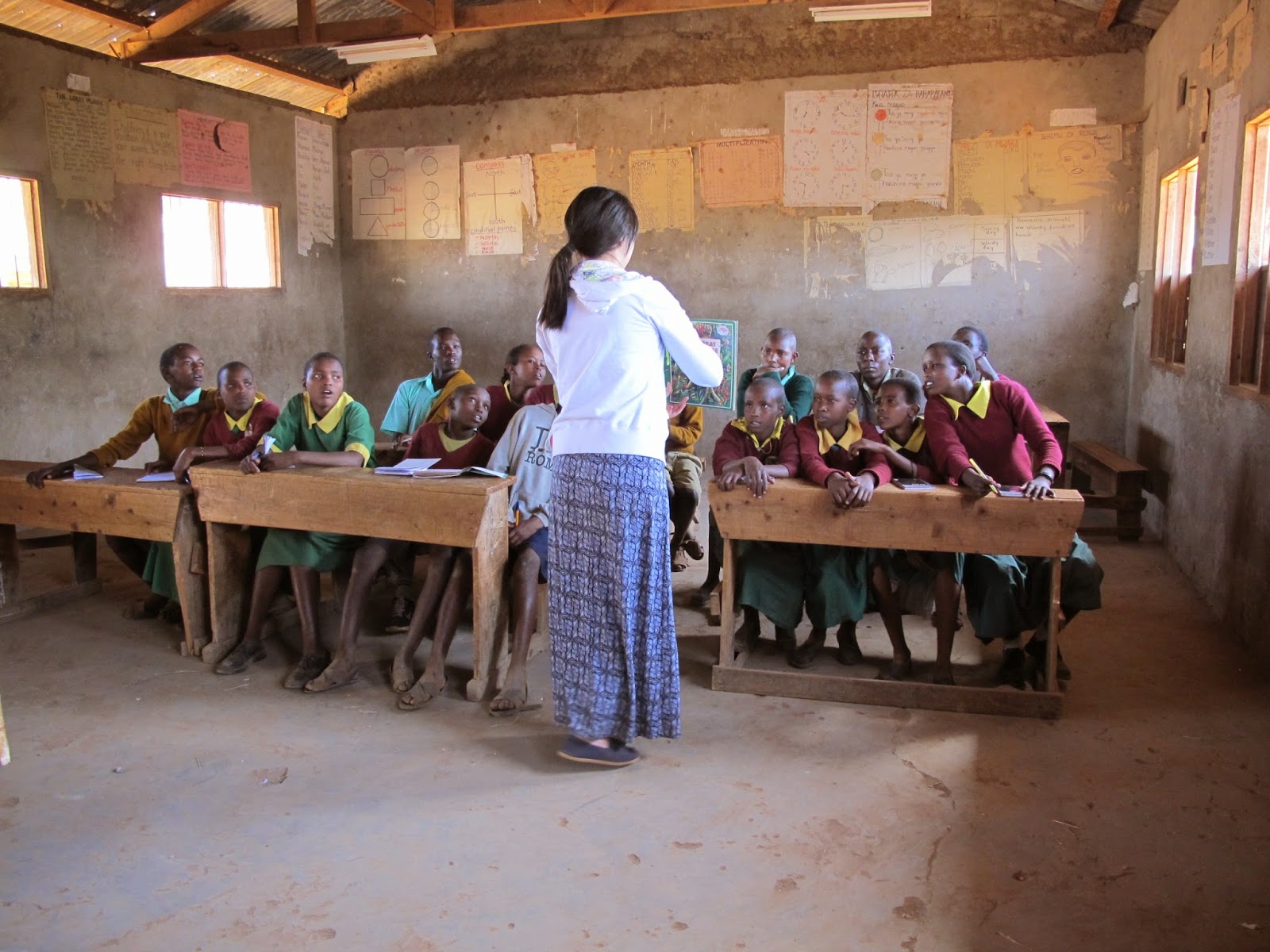
From a teaching perspective, I was really struck by the classroom and the number of students assigned to each class. While sitting in the head teacher's office, we noticed the enrollment numbers for each class, which were quite large. The overall teacher-student ratio is 1:71. The head teacher told us it's frustrating for many new teachers, who are qualified, as the government won't hire them. Though that is an issue with budgets in the US, it's not nearly to the same extreme. Thinking about my own teaching, I have had classes as small as five students and as large as thirty-nine. The difference in what you can do in terms of activities is huge. It is unsurprising that with classes this large Kenyan students aren't often engaged in full discussions. The conservation clubs try to promote experiential learning as much as possible and Nancy has helped to facilitate workshops for teachers to learn new methods. The layout of the classroom is very basic and all of the posters hanging on the walls were created by hand and are glued to the wall. These posters get ripped down at the end of the year, often leaving part of the poster behind. It's definitely made me feel spoiled about the classrooms I have taught in and will certainly make me think twice before complaining about wifi being slow!

Twende! Let's go!


Students practicing their poem for Community Conservation Day.

Helen reading to students.

The conservation club even has it's own little shed! You can't see it, but the charcoal balls were drying on the roof.

Crossing the river on the way home.

Giraffe sighting on the way home!

Friday, June 27, 2014

Dayton Visits Il Motiok Primary School

We arrived at Il Motiok Primary School early. The students still had plenty of class time left before the after-school Conservation Club I was there to help teach. Helen and some others left for Nai Perere, and I remained with Nancy and Alex. Nancy Rubenstein is a former elementary school teacher and the wife of Princeton ecologist Dan Rubenstein and the Conservation Clubs are largely their brainchild. Alex is a rising junior interning through the Princeton Environmental Institute as a teacher and she has prepared a lesson on birds and adaptations for this afternoon.

With permission from the Il Motiok teacher, we decided to sit in on a class until school was out. First we caught the tail end of a religious education class in which students were learning causes of suffering (war, sickness, sin, guilt, etc.) and, had time permitted, would have learned of Jesus Christ’s triumph over said suffering. A cursory Wikipedia search reveals Kenya first found Jesus in the form of Portuguese Catholics in the 1400s. Kenya’s colonization by the British from 1920-1963 cemented Christianity’s hold, and today roughly three-quarters of Kenyans are believers. (Other British influences can be found in their Anglicized names and driving on the left side of the road.) I don’t mean to comment on the merits of Christianity; instead, my thoughts drifted to the lasting power of colonialism. Parts of a culture were lost or irrevocably altered due to Western influence. As a white Westerner interacting with young Kenyans, I must be conscious of not overstepping my role.

The next class we saw was a science class. A different teacher went over the parts of the heart and drew a diagram on the board. His style was relaxed and informal, and he actively involved Nancy, Alex, and me (“Let’s ask our visitors what the smallest blood vessels are called”). The students seemed to be enjoying themselves, and I knew I was (“Capillaries!”).

After class, we met up again with the religious education teacher, Joseph, who also teaches the Conservation Club. He expressed discontentment with the way the kids are so often kept silent in their chairs, and declared that for today’s Club we would go on walk.

It was tempting to be frustrated. All the preparation for Alex’s bird lesson just (forgive me) flew out the window. But to be honest I was secretly pleased. Joseph, in the end, is the Club teacher, not Alex, Nancy, or I. If he felt his students had spent too much time inside, well, he knew better than we did.

We walked about 5-10 minutes to a rocky outcropping, past a glut of livestock (domestic goats are everywhere here. Apparently they eat more than their fair share of plants and are bad—dare I say baaaa-d?—for the environment, but between you and me I think they’re hilarious and kind of awesome). I tried to initiate conversation with one or two of the students, but due to their general shyness, unconfident English, or whatever else, I was woefully unsuccessful.

We sat down in the rocks, some of the kids flipping through animal-themed picture books they’d brought along. Joseph began to speak, as much to Nancy, Alex, and me as to the students. He pointed far out in the distance at what he claimed was an elephant, and the students seemed to agree. I’m inclined to believe them, and I think I might have seen it move, but I wouldn’t be shocked to find out it was just a big grey rock.

Elephants at Il Motiok are not quite as beloved as they are in the US. They had trampled and killed a woman three months ago in the area, and such events are not uncommon. While poaching (for ivory) and habitat degradation (especially cutting down trees) have sent elephants onto the endangered list worldwide, there are still quite a few in Il Motiok. Kenya’s textbooks take a pragmatic approach to conservation: elephants are good for tourism, which is good for the local economy, and thus Kenyans should protect their elephants. Joseph explained this to the students in a way that implied they had heard it all before. The tourism benefit might be true in the short term, but I am skeptical that conserving solely for this reason is a sustainable approach.

Luckily, Joseph also hinted at something more important. Discussing leopards, which are endangered due to—yet again—poaching (for their pelts) and habitat degradation (they live in trees), he had his students follow the food chain. “What happens to gazelles when there are no more leopards?” he asked.

The gazelle population, of course, would increase with fewer predators. More gazelles eat more grass, which means less grass left over for the goats, cows, and other livestock upon which human communities depend. (This is a simplification, but the principle stands.) Ecosystems are complex and sometimes fragile things, and humans are a part of them. We should think twice before tampering with the system, because we might bring ourselves down too.

This concept, while not simple, is fairly intuitive in this region of Kenya. Thinking ahead to the eventual object of my project with Helen—the development of a US curriculum—I realize a lot of work must be done with American students. Industrialization and urbanization have created an illusion in the states that the human world and the environment are two separate things. Resource depletion and climate change are showing us just how dangerous this misconception can be, but these threats are less obvious than “my goat shares grass with this gazelle.”

Making the connection between humans and the natural world is hugely important; to save the environment is to save a part of ourselves. I personally feel obligated to point out that even if this weren’t true, I believe we have a moral responsibility to other living things, especially the more intelligent ones like elephants. However, even an anthropocentric ethic is enough to motivate conservation; Helen and I will have to show American students that humans have a place in nature, that Earth is a finite, sensitive home.

When Joseph ran out of things to say, we still had a few minutes left. In honor of the recent inaugural World Giraffe Day, Alex led the kids in a true-or-false-type game with giraffe facts. I let my ecological ruminations slide and watched the game. Honestly, I hadn’t known most of the facts, and I learned a lot. Did you know giraffes can run 50 kilometers per hour? Or that their calves can stand on their own five minutes after birth? These days, it’s easy to attach my knowledge of the non-human world to all this high-minded moral responsibility stuff. I’m glad I haven’t forgotten that it’s also really cool.

When it comes to the elephant, students sometimes confuse the words 'endangered' and 'dangerous.'

My beloved goats

Seriously goats are everywhere.

Wild dogs reclaim the streets.

Wednesday, June 25, 2014

Check out Mpala Live to see the wildlife

The Mpala Live webcamera at the watering hole is very cool.

Take a look at the animals yourself .

You can also access the webcam feed via the Mpala Live tab on the navigation bar.